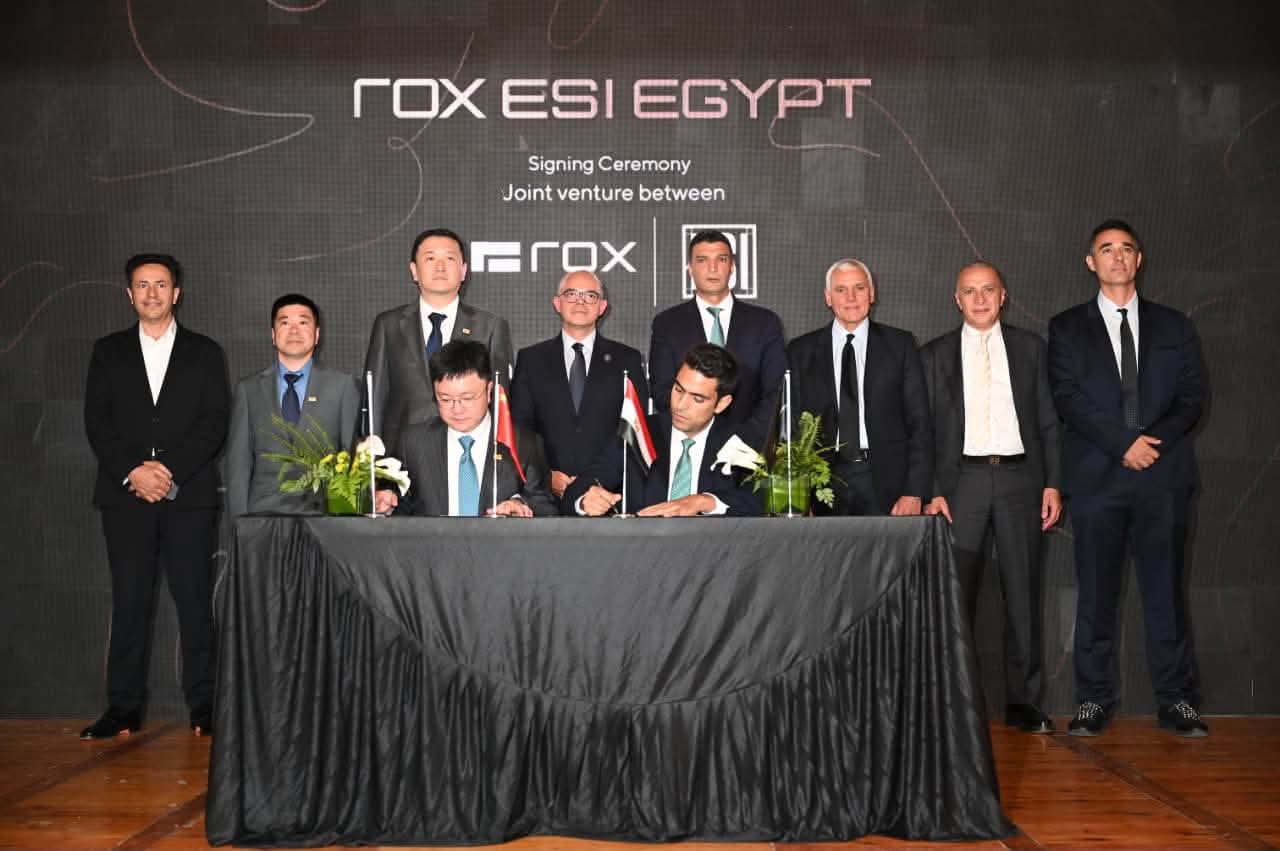
Egypt has officially launched a partnership between Ezz Elarab Elsewedy Investments Group and ROX Motor to manufacture ROX new-energy vehicles in Egypt.
The project will be based at the existing Ezz Elarab Elsewedy automotive plant, the total investment of which exceeds USD100 million, and which currently has an annual production capacity of around 40,000 vehicles. Capacity is planned to expand to more than 80,000 vehicles per year in later phases.
ROX vehicle production is expected to begin in the second or third quarter of 2027. Output is planned to reach around 10,000 vehicles per year within the first three years.
More than 50 per cent of the initial production is intended for export to Gulf and African markets starting the second half of 2027.
Ezz Elarab Elsewedy Investments Group is a joint venture between Egypt’s Ezz Elarab Group, a major automotive distributor and mobility company, and Elsewedy Capital, the investment arm of Elsewedy Electric. The group focuses on automotive manufacturing and mobility-related investments in Egypt, including the development of the Ezz Elarab Elsewedy automotive plant.
ROX Motor is a Chinese new-energy vehicle manufacturer established in 2021 and backed by Chinese entrepreneur Chang Jing. The company specialises in premium electric and extended-range electric SUVs, with its flagship model marketed in several international markets.
According to Minister of Investment and Foreign Trade, Mohamed Farid Saleh, the project is in line with the government strategy of developing a domestic new-energy vehicle industry, which it views as a key sector for technology transfer, increasing local content, and expanding Egypt’s automotive supply chain. Opportunities are expected in supporting industries such as batteries, electronics, wiring harnesses, sensors, tires, glass, and plastic and rubber components.
Dr Saleh said that the government is updating the National Automotive Industry Development Programme, increasing local-content levels, and expanding the supplier base. It is also working to simplify licensing procedures and improve investor services from project establishment through export-market access.
The project will be eligible for investment incentives available under Egypt’s automotive, customs, and investment frameworks, including incentives under the National Automotive Industry Development Program, customs facilitation for machinery, equipment, and production lines, reduced customs tariff rates in certain cases, and duty-drawback mechanisms for inputs used in exports.