
Editor in Chief
Youssef Sidhom
Watani
عربى English French
  • News
    • Accidents
    • Crime
    • Diplomatic briefcase
    • NewsLine
    • Outside Cairo
    • Special Occasions
  • Opinion
    • Editorial
    • International media
    • Reader`s Corner
    • Opinion
  • Politics
    • Elections
    • International Politics
    • Islamisation Politics
    • National Affairs
    • Parliament
    • Politics
    • Protests
    • Rights
    • Terrorism
  • Culture
    • Antiquity
    • Art
    • Books
    • Culture
    • Drama
    • Egyptology
    • Festivals
    • Films
    • Heritage
    • Islamisation Culture
    • Media
    • Museums
    • Music
    • TV
  • Coptic
    • Church Affairs
    • Coptic Affairs
    • Coptic Culture
    • Copts in the Media
    • Coptology
    • Copts Abroad
    • Religious
      • P. Shenouda: Bible Study
    • Sectarian
    • Inter-religious
    • Holy Family
  • Features
    • Counselling Corner
    • features
    • Economy
      • Business
    • Education
    • Social Issues
      • Behaviour
      • Mothers Day
    • Health
    • Environment
    • Humour
    • In memorial
    • Interviews
    • Nile
    • Profile
    • Special needs
    • Sports
    • Technology
    • Tourism
    • Wars
    • Women
    • Youth
  • Watani Special Features
    • Egypt – Arab Spring
      • 25 January Revolution
      • 25 Jan revolution, one year on
      • Egypt post-30 June
    • Watani Milestones
      • 20 years Watani International
      • 10 years Watani International
      • Watani Jubilee
    • Pope Shenouda
    • Pope Tawadros
    • Watani Forum
No Result
View All Result
  • News
    • Accidents
    • Crime
    • Diplomatic briefcase
    • NewsLine
    • Outside Cairo
    • Special Occasions
  • Opinion
    • Editorial
    • International media
    • Reader`s Corner
    • Opinion
  • Politics
    • Elections
    • International Politics
    • Islamisation Politics
    • National Affairs
    • Parliament
    • Politics
    • Protests
    • Rights
    • Terrorism
  • Culture
    • Antiquity
    • Art
    • Books
    • Culture
    • Drama
    • Egyptology
    • Festivals
    • Films
    • Heritage
    • Islamisation Culture
    • Media
    • Museums
    • Music
    • TV
  • Coptic
    • Church Affairs
    • Coptic Affairs
    • Coptic Culture
    • Copts in the Media
    • Coptology
    • Copts Abroad
    • Religious
      • P. Shenouda: Bible Study
    • Sectarian
    • Inter-religious
    • Holy Family
  • Features
    • Counselling Corner
    • features
    • Economy
      • Business
    • Education
    • Social Issues
      • Behaviour
      • Mothers Day
    • Health
    • Environment
    • Humour
    • In memorial
    • Interviews
    • Nile
    • Profile
    • Special needs
    • Sports
    • Technology
    • Tourism
    • Wars
    • Women
    • Youth
  • Watani Special Features
    • Egypt – Arab Spring
      • 25 January Revolution
      • 25 Jan revolution, one year on
      • Egypt post-30 June
    • Watani Milestones
      • 20 years Watani International
      • 10 years Watani International
      • Watani Jubilee
    • Pope Shenouda
    • Pope Tawadros
    • Watani Forum
No Result
View All Result
No Result
View All Result
Watani
ع Fr
ADVERTISEMENT

Uproar over emergency

15 December, 2011 - (9:05 AM)
0 0

Adel Mounir-Nader Shukry

Uproar over emergency
12
VIEWS
Share on FacebookShare on Twitter

WATANI International
30 May 2010

The emergency law has been extended for two more years

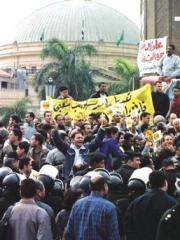
A two-year extension of the emergency law that has been in place since 1981 has been endorsed by more than two thirds of People’s Assembly members. Out of 454, 308 MPs sanctioned the extension while 103 opposition and independent MPs, including those affiliated to the outlawed Muslim Brotherhood, voted against it.
Unlike previous extensions, a group of amendments was introduced to strip the government of the powers of monitoring all forms of communication, censoring and confiscation of media and publications, closure of publishing houses and broadcast stations, and evacuation and isolation of certain areas.
Although the government pledged to confine emergency powers to cases of terrorism and drug-trafficking, the move drew criticism from activists and human rights groups on the grounds that the law undermined civil liberties and imposed restrictions on the freedom of expression.

Government defence
In his address requesting the extension of the law, Prime Minister Ahmed Nazif told the assembly that the state of emergency helped preserve national security and had foiled a host of terrorist crimes over the past years. “The President,” he added “is keen to dispel doubts through including restrictions on the use of emergency powers so they are invoked only in cases of terrorist threats and drug-trafficking.”
Meanwhile, the Egyptian government issued a statement written in English and justifying its motion. The statement said that the main objective of the extension was to confront threats to national security since the country was targeted by groups opposing the Egyptian-Israeli peace treaty as well as ongoing efforts to reach a peaceful settlement in the Middle East. To further defend the government position, the statement hinted to the ploy by the Lebanese Shi’ite party Hizbullah to smuggle arms and ammunition into the Palestinian occupied territories. Moreover, it said that Israel had applied a state of emergency ever since its formation in 1948, while Pakistan, Turkey, Syria and Algeria had lived for several years under the state of emergency.

Anti-terror law
Watani sounded the opinion of a group of pundits, human rights activists and politicians from across the spectrum. Major General Fouad Allam, a former head of the state security apparatus, expressed his opposition to the extension and called instead for promulgating the anti-terror law promised some five years ago. As for the amendments to the law, Mr Allam believes they provide some guarantees that the coming legislative elections due in November will be free. “According to the latest amendments to the emergency law, detention should not last for more than 24 hours, and can only be extended by an order from the prosecutor,” he added. “But the question of releasing those detained for years without trial is yet to be settled.”

Oppressive practices
Mustafa Kamel al-Sayed, professor of political science at Cairo University, launched a scathing attack on the Egyptian government. “The claim that the application of emergency law would be restricted to cases of terrorism and narcotics trafficking is an insult to our intelligence, since everybody knows that the Interior Ministry will be free-handed in fabricating charges and making arrests,” he said. “The law will continue to curb public freedoms. In 29 years, the law has failed to put an end to drug trafficking or terrorist attacks. Ordinary law is sufficient to address those situations. The main objective of the state of emergency is to protect the ruling regime and manipulate the legislative and presidential elections to the advantage of the ruling National Democratic Party. The law tarnishes Egypt’s image before the outside world.”
Human rights activist Negad al-Bora’i dismissed government promises to confine the application of emergency power to terrorism and narcotics trafficking as nonsense. “We have got used to these lies, and everybody knows that the emergency law will be applied without any reservation and the pledges to release the political prisoners detained for years without trial are no more than empty rhetoric.”

Cosmetic changes
Mounir Fakhri Abdel-Nour, secretary-general of the liberal Wafd Party, expressed regret over the decision to extend the state of emergency. In his presidential election programme, he said, President Mubarak pledged to scrap the emergency law in favour of anti-terror legislation, but failed to do so. “Criminal law is capable of dealing with terrorism and drug-dealing. Instead of introducing cosmetic changes to the law, the government should have respected the public’s will,” he concluded.
George Ishaq, a leading member of the National Association for Change formed by Mohamed el-Baradi, former director-general of the International Atomic Energy Agency and a potential presidential candidate, believes the state of emergency mainly targets political dissidents. “The government used to say that the use of the law would be restricted to crimes of terrorism and drug-trafficking, but these claims proved to be false. The security authorities have the power to fabricate terrorism charges against the regime’s opponents,” he said.

Religious freedom hounded
Among the targets of the state of emergency are followers of religious doctrines. The Egyptian Initiative for Personal Rights (EIPR) asked Interior Minister Habib al-Adly to order the instant release of nine people detained for two months for adhering to the Ahmadi doctrine, on charges of contempt of religion. Ahmadis believe that a 19th-century Indian mystic named Mirza Gulam Ahmed was the Messiah whose coming was predicted by the Prophet Mohamed. The group called on the prosecutor-general to halt the investigations conducted by State security prosecution and hold officials who arrest people on the basis of religious affiliation to account.

More restrictions
In a joint statement, 13 NGOs expressed alarm over the renewal of the state of emergency. “In practical terms this means more emergency in Egypt, more arrests, more restrictions on liberties and more obstruction of the law and constitution,” they warned. “We believe there is a clear connection between the renewal of the emergency law and the series of elections slated in the country over the next two years.” As for the stipulation that implementation of the law will be limited to those listed in articles 1 and 5 of the emergency law, the statement shows that the two articles leave security apparatuses free handed in arresting whom they dub suspects. Finally, signatories vowed to struggle against the law along with the human rights violations it breeds.
Last week, the Egyptian Organisation for Human Rights (EOHR) organised a seminar entitled “Towards a future with no state of emergency”. Hafez Abu-Saeda, secretary-general of the EOHR, called for the formation of a national committee to exert pressure on the government to put an end to the state of emergency.


Comments

comments

Tags: emergencyoverUproar

Related Posts

Archive Articles


SAINTE CATHERINE LABOURÉ, Servante des pauvres


December 15, 2011
Archive Articles

Agenda

December 15, 2011
DJ Zebra au Caire
Archive Articles

DJ Zebra au Caire

December 15, 2011
Archive Articles

Au caire le président américain visite la mosquée du Sultan Hassan

December 15, 2011
Archive Articles

“Nouveau départ entre les musulmans et les États-Unis”

December 15, 2011
Archive Articles

Principales œuvres

December 15, 2011

Editorial

China and Russia vis-à-vis Trump’s Iran War

More

MOST READ

Egypt attempts to contain Myna bird invasion
Environment

Egypt attempts to contain Myna bird invasion

June 15, 2026
0

The Nature Protection Sector of Egypt’s Ministry of Local Development and Environment has been monitoring and tracking the spread of...

Read more
Watani talks to Anba Bigol, Bishop and Abbot of al-Muharraq Monastery of the Holy Virgin Mary

Watani talks to Anba Bigol, Bishop and Abbot of al-Muharraq Monastery of the Holy Virgin Mary

June 17, 2026
Egypt’s Armenians

Egypt’s Armenians

April 22, 2015
‘Train of Hope’ to carry home 1,200 Sudanese

‘Train of Hope’ to carry home 1,200 Sudanese

June 16, 2026
Jobs for persons with disabilities

Jobs for persons with disabilities

June 15, 2026

Features

China’s Long March launches USD190M tyre manufacturing project in Egypt
Economy

China’s Long March launches USD190M tyre manufacturing project in Egypt

June 17, 2026
0

China’s Chaoyang Long March Tyre Co., Ltd. has launched a USD190 million tyre manufacturing project in Egypt’s Suez Canal Economic...

Read more
Watani started as an Egyptian weekly Sunday newspaper published in Cairo. The word Watani is Arabic for “My Homeland”. The paper was founded in 1958 by the prominent Copt Antoun Sidhom (1915 – 1995), who strove for the establishment of a civil, democratic society in Egypt, where all Egyptians would enjoy full citizenship rights regardless of their religious denomination. To this day when Watani is published as a weekly paper and an online news site, the objective remains the same. Those in charge of Watani view this role as a patriotic all-Egyptian vocation. Special attention is given to shedding light on Coptic culture and tradition as authentically Egyptian, this being a topic largely disregarded or little-understood by Egypt’s media. Watani is deeply dedicated to offer its readers high quality, extensive, objective, credible and well-researched media coverage, with special focus on Coptic issues, culture, heritage, and contribution to Egyptian society.
-----------------------------------------------------------

27 Abdel Khalek Tharwat st, Downtown, Abdeen,Cairo

00202-23927201

00202-23935946

 [email protected]


categories

  • News
  • Opinion
  • Politics
  • Culture
  • Egypt – Arab Spring
  • Coptic Affairs
  • Features
  • Watani Special Features

Recent Posts

  • China and Russia vis-à-vis Trump’s Iran War
  • China’s Long March launches USD190M tyre manufacturing project in Egypt
  • Watani talks to Anba Bigol, Bishop and Abbot of al-Muharraq Monastery of the Holy Virgin Mary
  • ‘Train of Hope’ to carry home 1,200 Sudanese
  • Egypt launches ROX Motor partnership to manufacture new-energy vehicles
  • News
  • Opinion
  • Politics
  • Culture
  • Egypt – Arab Spring
  • Coptic Affairs
  • Features
  • Watani Special Features

Powered BY 3A Digital.

No Result
View All Result
  • News
    • Accidents
    • Crime
    • Diplomatic briefcase
    • NewsLine
    • Outside Cairo
    • Special Occasions
  • Opinion
    • Editorial
    • International media
    • Reader`s Corner
    • Opinion
  • Politics
    • Elections
    • International Politics
    • Islamisation Politics
    • National Affairs
    • Parliament
    • Politics
    • Protests
    • Rights
    • Terrorism
  • Culture
    • Antiquity
    • Art
    • Books
    • Culture
    • Drama
    • Egyptology
    • Festivals
    • Films
    • Heritage
    • Islamisation Culture
    • Media
    • Museums
    • Music
    • TV
  • Coptic
    • Church Affairs
    • Coptic Affairs
    • Coptic Culture
    • Copts in the Media
    • Coptology
    • Copts Abroad
    • Religious
      • P. Shenouda: Bible Study
    • Sectarian
    • Inter-religious
    • Holy Family
  • Features
    • Counselling Corner
    • features
    • Economy
      • Business
    • Education
    • Social Issues
      • Behaviour
      • Mothers Day
    • Health
    • Environment
    • Humour
    • In memorial
    • Interviews
    • Nile
    • Profile
    • Special needs
    • Sports
    • Technology
    • Tourism
    • Wars
    • Women
    • Youth
  • Watani Special Features
    • Egypt – Arab Spring
      • 25 January Revolution
      • 25 Jan revolution, one year on
      • Egypt post-30 June
    • Watani Milestones
      • 20 years Watani International
      • 10 years Watani International
      • Watani Jubilee
    • Pope Shenouda
    • Pope Tawadros
    • Watani Forum

Powered BY 3A Digital.

Login to your account below

Forgotten Password?

Fill the forms bellow to register

All fields are required. Log In

Retrieve your password

Please enter your username or email address to reset your password.

Log In