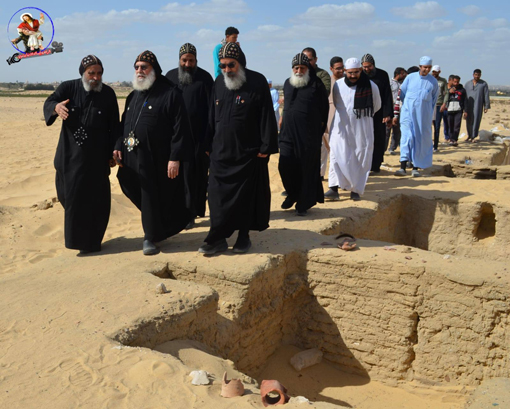

Anba Aghapius, Bishop and Abbot of the monastery of Anba Bishoy in Wadi al-Natroun in Egypt’s Western Desert, some 120km northwest Cairo, paid an inspection visit to the site of a new archaeological discovery of buried monasteries in the area. The discovery was recently announced by the Egyptian Ministry of Antiquities.
During his visit, Anba Aghapius was briefed on the details of the discovery which dates back to some time between the fourth and sixth centuries, a prominent period in the beginnings of monastic life in Egypt and the world. He stressed that the discovery represents an important addition to the documentation of the history of the first monasteries.
The Abbot praised the efforts of the archeological mission that made the discovery, a joint mission between the Supreme Council of Antiquities and Cairo University’s Faculty of Archeology. He said he deeply appreciated the cooperation between the Coptic Church and government authorities to preserve and highlight Coptic heritage.
The Ministry of Tourism and Antiquities had announced, in a statement issued by Egypt’s Cabinet, the success of the joint Egyptian archeological mission in revealing the remains of a 4th to 6th-century monastery in the area of the buried monasteries in Wadi al-Natroun, one of the most pivotal areas associated with the emergence and development of early Christian monastic life in Egypt.
The statement explained that the unearthed monastery extended over some 2000sq.m. Its buildings were of mud brick, the outer walls 1 metre thick whereas the walls of buildings inside the walls were 60 – 70cm in thickness. The monastery included a central open courtyard surrounded by various architectural units, including monk cells of different forms and areas, in addition to a range of service buildings such as kitchens, ovens and store rooms.
Excavation work also led to the discovery of burial places containing human bones that likely belonged to the monks.
Studies have shown the use of multiple roofing systems such as vaults and domes, with layers of white mortar.
Wall motifs included crosses, palm trees, and Coptic graffiti of the names of monks praying for mercy and forgiveness.
Sherif Fathi, Minister of Tourism and Antiquities, stressed that the discovery represents a qualitative addition to understanding the beginnings of monasticism that started in Egypt and spread to the world, pointing to the importance of Wadi al-Natroun as a prominent spiritual and historical monastic centre.
Watani International
26 March 2026