
Editor in Chief
Youssef Sidhom
Watani
عربى English French
  • News
    • Accidents
    • Crime
    • Diplomatic briefcase
    • NewsLine
    • Outside Cairo
    • Special Occasions
  • Opinion
    • Editorial
    • International media
    • Reader`s Corner
    • Opinion
  • Politics
    • Elections
    • International Politics
    • Islamisation Politics
    • National Affairs
    • Parliament
    • Politics
    • Protests
    • Rights
    • Terrorism
  • Culture
    • Antiquity
    • Art
    • Books
    • Culture
    • Drama
    • Egyptology
    • Festivals
    • Films
    • Heritage
    • Islamisation Culture
    • Media
    • Museums
    • Music
    • TV
  • Coptic
    • Church Affairs
    • Coptic Affairs
    • Coptic Culture
    • Copts in the Media
    • Coptology
    • Copts Abroad
    • Religious
      • P. Shenouda: Bible Study
    • Sectarian
    • Inter-religious
    • Holy Family
  • Features
    • Counselling Corner
    • features
    • Economy
      • Business
    • Education
    • Social Issues
      • Behaviour
      • Mothers Day
    • Health
    • Environment
    • Humour
    • In memorial
    • Interviews
    • Nile
    • Profile
    • Special needs
    • Sports
    • Technology
    • Tourism
    • Wars
    • Women
    • Youth
  • Watani Special Features
    • Egypt – Arab Spring
      • 25 January Revolution
      • 25 Jan revolution, one year on
      • Egypt post-30 June
    • Watani Milestones
      • 20 years Watani International
      • 10 years Watani International
      • Watani Jubilee
    • Pope Shenouda
    • Pope Tawadros
    • Watani Forum
No Result
View All Result
  • News
    • Accidents
    • Crime
    • Diplomatic briefcase
    • NewsLine
    • Outside Cairo
    • Special Occasions
  • Opinion
    • Editorial
    • International media
    • Reader`s Corner
    • Opinion
  • Politics
    • Elections
    • International Politics
    • Islamisation Politics
    • National Affairs
    • Parliament
    • Politics
    • Protests
    • Rights
    • Terrorism
  • Culture
    • Antiquity
    • Art
    • Books
    • Culture
    • Drama
    • Egyptology
    • Festivals
    • Films
    • Heritage
    • Islamisation Culture
    • Media
    • Museums
    • Music
    • TV
  • Coptic
    • Church Affairs
    • Coptic Affairs
    • Coptic Culture
    • Copts in the Media
    • Coptology
    • Copts Abroad
    • Religious
      • P. Shenouda: Bible Study
    • Sectarian
    • Inter-religious
    • Holy Family
  • Features
    • Counselling Corner
    • features
    • Economy
      • Business
    • Education
    • Social Issues
      • Behaviour
      • Mothers Day
    • Health
    • Environment
    • Humour
    • In memorial
    • Interviews
    • Nile
    • Profile
    • Special needs
    • Sports
    • Technology
    • Tourism
    • Wars
    • Women
    • Youth
  • Watani Special Features
    • Egypt – Arab Spring
      • 25 January Revolution
      • 25 Jan revolution, one year on
      • Egypt post-30 June
    • Watani Milestones
      • 20 years Watani International
      • 10 years Watani International
      • Watani Jubilee
    • Pope Shenouda
    • Pope Tawadros
    • Watani Forum
No Result
View All Result
No Result
View All Result
Watani
ع Fr
ADVERTISEMENT

A snake here, a crocodile there …

15 December, 2011 - (9:06 AM)
0 0

Mervat Ayoub

A snake here, a crocodile there …
246
VIEWS
Share on FacebookShare on Twitter

WATANI International
12 December 2010


The illegal trade in animals
According to a recent study, the Internet has become a secret haven for the sale of exotic pets and animal products. Sadly, many of these sales involve endangered species and are strictly illegal.
According to the study by the International Fund for Animal Welfare (IFAW), the thousands of endangered animals and animal products for sale over the Internet included a live Siberian tiger, a lion, peregrine falcons, and medicines made from leopard, tiger, rhinoceros and elephant parts.
Over a one-week period IFAW found more than 9,000 live wild animals and animal products and specimens for sale, predominantly from species under legal protection. The animals and products were offered on animal-trading websites, in chat rooms and on auction sites like eBay.
IFAW stresses that the sale of endangered animals and products—and of exotic pets—gives poachers an incentive to keep hunting them and further increases their vulnerability.


Snakes in Abu Rawash
In Egypt, snakes and scorpions are the scourge of rural and desert areas. They spill over into village and town homes, especially in the warmer weather during spring and summer. Given that it is difficult to tell a poisonous snake from a non-poisonous one at first glimpse, it is a popular tradition for families to take no risks and quickly call in a ‘snake catcher’. It is only recently that the Civil Defence Authority has stepped in to allow Cairenes to call a hotline to ask for help once they find a snake at home.
Mainstream Egyptians thus may not look kindly on the idea of ‘conserving snakes’. It will require a strong media campaign to educate people to the idea that getting rid of them might lead to a better night’s sleep but could threaten entire species with extinction and damage delicate ecosystems.
Catching snakes is not always an innocent activity. Reptile hunting is a business—in many instances an illegal business—for some families in Egypt, says Abdullah Moussa, the owner of a company that imports and exports reptiles. The village of Abu Rawash, not far from Cairo, is notorious as a centre for the trade in wild and exotic animals. With a population of 5,000 and located just six kilometres from the Giza Pyramids, it is now part of the 6th October governorate west of Cairo. Among its residents is the Tolba family, the most famous snake-hunting family in Egypt.
Tolba earns a meagre livelihood catching cobras with his bare hands. Although few people have heard of him, even in Egypt, he is the most prominent resident in the strange corner known as the ‘City of Snakes’.


Endangered
There are some 36 species of snake in Egypt, Mr Moussa says, 10 of which are poisonous. Among the most poisonous species are the Egyptian and Indian Cobras and the deadly Egyptian Horned Viper. In addition to the snakes, some arachnids such as scorpions and spiders can inflict fatal bites.
Catching snakes is dangerous and needs careful training. In desert areas it requires learning to track reptile marks in the sand. When caught, Moussa says, the snakes are placed in an appropriate climate that matches their environment.
Salah Mahdi, a member of the Tolba clan says the animals most in demand for export are tortoises and poisonous snakes, as well as Fennec foxes, but he says their export has recently been prohibited because they are endangered species.


Lucrative trade
The prices of reptiles in Egypt vary, according to Mahdi. A cobra, for instance, sells for EGP50 and can be exported for USD100; while other poisonous snakes could go up to EGP950 on the home market but could fetch USD2,000 abroad.
According to Mahdi there is an increasing demand for Egyptian frogs in the European market, especially in France where people regard frog’s legs as a delicacy.
Since the export of wild animals could bring in hard currency to Egypt, Mahdi asks why the Egyptian government, and specifically the ministries of environment and agriculture, does not allow the export of some of these species rather than imposing restrictions on the trade. He appears oblivious of the fact that these “hard currency earners” may not be there for long if the hunting and trading goes on.
Abdullah Heggawi, who heads the environmental protection authority in al-Arish, North Sinai, says the environmental and biological balance of the Egyptian deserts need to be maintained for the reptile and insect species to survive. The problem, he says, lies in the fact that no governmental or civil authority has exact statistics on the existing numbers of reptiles, animals and plants.
The Bedouin, Mr Heggawi adds, prefer to continue to acquire reptiles—especially tortoises, which can sell for EGP65 and export for USD40 to US100.


CITES
CITES, the Convention on International Trade in Endangered Species, is an international agreement covering the illegal trade in protected and endangered species.
Sami Zalat, professor of science at Suez University, predicts that the haphazard and illegal collecting of certain animals from the Egyptian wild will lead to catastrophe. Frog numbers are threatened by research centres and university scientific laboratories, which use 4.5 million of them annually for research purposes.
Hamdi Abdel-Hamid from Mansoura University agrees. Laws protecting animal diversity in Egypt are totally inadequate and in any case are not implemented, Dr Abdel-Hamid says. He calls for urgent action by government ministries.
In 2000 a ministerial decree was issued by the former agriculture minister, Youssef Wali, concerning the breeding, importing and exporting of wild animals by investors and owners of tourist resorts. The decree stipulated that animals could only be moved from one place to another under specific conditions. Yet even this has not been implemented.


Nile crocodile
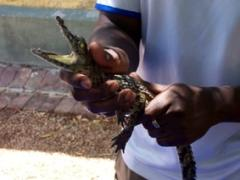
The Nile crocodile is in itself a special case. CITES lists the Nile crocodile under Appendix I (threatened with extinction) in most of its range; and under Appendix II (not threatened, but trade must be controlled) in the remainder, which either allows ranching or sets an annual quota of skins taken from the wild. The Conservation Status of the Nile crocodile under the 1996 World Conservation Union (IUCN) Red List is ‘Lower Risk’.
According to a study by Danish researchers, there are 70,000 giant crocodiles in Lake Nasser. The crocodiles threaten the lives of fishermen and consume more than 150,000 tonnes of fishes daily.
The study revealed that if the crocodile population is allowed to grow unchecked it could threaten the safety of gates of the Aswan High Dam.
Comments

comments

Tags: crocodileheresnakethere

Related Posts

China’s Long March launches USD190M tyre manufacturing project in Egypt
Economy

China’s Long March launches USD190M tyre manufacturing project in Egypt

June 17, 2026
Watani talks to Anba Bigol, Bishop and Abbot of al-Muharraq Monastery of the Holy Virgin Mary
Coptic Affairs

Watani talks to Anba Bigol, Bishop and Abbot of al-Muharraq Monastery of the Holy Virgin Mary

June 17, 2026
‘Train of Hope’ to carry home 1,200 Sudanese
E Choise

‘Train of Hope’ to carry home 1,200 Sudanese

June 16, 2026
Egypt launches ROX Motor partnership to manufacture new-energy vehicles
E Choise

Egypt launches ROX Motor partnership to manufacture new-energy vehicles

June 16, 2026
Developing skilled workforce for SCZone
Economy

Developing skilled workforce for SCZone

June 15, 2026
Jobs for persons with disabilities
NewsLine

Jobs for persons with disabilities

June 15, 2026

Editorial

China and Russia vis-à-vis Trump’s Iran War

More

MOST READ

Egypt attempts to contain Myna bird invasion
Environment

Egypt attempts to contain Myna bird invasion

June 15, 2026
0

The Nature Protection Sector of Egypt’s Ministry of Local Development and Environment has been monitoring and tracking the spread of...

Read more
Watani talks to Anba Bigol, Bishop and Abbot of al-Muharraq Monastery of the Holy Virgin Mary

Watani talks to Anba Bigol, Bishop and Abbot of al-Muharraq Monastery of the Holy Virgin Mary

June 17, 2026
Egypt’s Armenians

Egypt’s Armenians

April 22, 2015
‘Train of Hope’ to carry home 1,200 Sudanese

‘Train of Hope’ to carry home 1,200 Sudanese

June 16, 2026
Jobs for persons with disabilities

Jobs for persons with disabilities

June 15, 2026

Features

China’s Long March launches USD190M tyre manufacturing project in Egypt
Economy

China’s Long March launches USD190M tyre manufacturing project in Egypt

June 17, 2026
0

China’s Chaoyang Long March Tyre Co., Ltd. has launched a USD190 million tyre manufacturing project in Egypt’s Suez Canal Economic...

Read more
Watani started as an Egyptian weekly Sunday newspaper published in Cairo. The word Watani is Arabic for “My Homeland”. The paper was founded in 1958 by the prominent Copt Antoun Sidhom (1915 – 1995), who strove for the establishment of a civil, democratic society in Egypt, where all Egyptians would enjoy full citizenship rights regardless of their religious denomination. To this day when Watani is published as a weekly paper and an online news site, the objective remains the same. Those in charge of Watani view this role as a patriotic all-Egyptian vocation. Special attention is given to shedding light on Coptic culture and tradition as authentically Egyptian, this being a topic largely disregarded or little-understood by Egypt’s media. Watani is deeply dedicated to offer its readers high quality, extensive, objective, credible and well-researched media coverage, with special focus on Coptic issues, culture, heritage, and contribution to Egyptian society.
-----------------------------------------------------------

27 Abdel Khalek Tharwat st, Downtown, Abdeen,Cairo

00202-23927201

00202-23935946

 [email protected]


categories

  • News
  • Opinion
  • Politics
  • Culture
  • Egypt – Arab Spring
  • Coptic Affairs
  • Features
  • Watani Special Features

Recent Posts

  • China and Russia vis-à-vis Trump’s Iran War
  • China’s Long March launches USD190M tyre manufacturing project in Egypt
  • Watani talks to Anba Bigol, Bishop and Abbot of al-Muharraq Monastery of the Holy Virgin Mary
  • ‘Train of Hope’ to carry home 1,200 Sudanese
  • Egypt launches ROX Motor partnership to manufacture new-energy vehicles
  • News
  • Opinion
  • Politics
  • Culture
  • Egypt – Arab Spring
  • Coptic Affairs
  • Features
  • Watani Special Features

Powered BY 3A Digital.

No Result
View All Result
  • News
    • Accidents
    • Crime
    • Diplomatic briefcase
    • NewsLine
    • Outside Cairo
    • Special Occasions
  • Opinion
    • Editorial
    • International media
    • Reader`s Corner
    • Opinion
  • Politics
    • Elections
    • International Politics
    • Islamisation Politics
    • National Affairs
    • Parliament
    • Politics
    • Protests
    • Rights
    • Terrorism
  • Culture
    • Antiquity
    • Art
    • Books
    • Culture
    • Drama
    • Egyptology
    • Festivals
    • Films
    • Heritage
    • Islamisation Culture
    • Media
    • Museums
    • Music
    • TV
  • Coptic
    • Church Affairs
    • Coptic Affairs
    • Coptic Culture
    • Copts in the Media
    • Coptology
    • Copts Abroad
    • Religious
      • P. Shenouda: Bible Study
    • Sectarian
    • Inter-religious
    • Holy Family
  • Features
    • Counselling Corner
    • features
    • Economy
      • Business
    • Education
    • Social Issues
      • Behaviour
      • Mothers Day
    • Health
    • Environment
    • Humour
    • In memorial
    • Interviews
    • Nile
    • Profile
    • Special needs
    • Sports
    • Technology
    • Tourism
    • Wars
    • Women
    • Youth
  • Watani Special Features
    • Egypt – Arab Spring
      • 25 January Revolution
      • 25 Jan revolution, one year on
      • Egypt post-30 June
    • Watani Milestones
      • 20 years Watani International
      • 10 years Watani International
      • Watani Jubilee
    • Pope Shenouda
    • Pope Tawadros
    • Watani Forum

Powered BY 3A Digital.

Login to your account below

Forgotten Password?

Fill the forms bellow to register

All fields are required. Log In

Retrieve your password

Please enter your username or email address to reset your password.

Log In