
Editor in Chief
Youssef Sidhom
Watani
عربى English French
  • News
    • Accidents
    • Crime
    • Diplomatic briefcase
    • NewsLine
    • Outside Cairo
    • Special Occasions
  • Opinion
    • Editorial
    • International media
    • Reader`s Corner
    • Opinion
  • Politics
    • Elections
    • International Politics
    • Islamisation Politics
    • National Affairs
    • Parliament
    • Politics
    • Protests
    • Rights
    • Terrorism
  • Culture
    • Antiquity
    • Art
    • Books
    • Culture
    • Drama
    • Egyptology
    • Festivals
    • Films
    • Heritage
    • Islamisation Culture
    • Media
    • Museums
    • Music
    • TV
  • Coptic
    • Church Affairs
    • Coptic Affairs
    • Coptic Culture
    • Copts in the Media
    • Coptology
    • Copts Abroad
    • Religious
      • P. Shenouda: Bible Study
    • Sectarian
    • Inter-religious
    • Holy Family
  • Features
    • Counselling Corner
    • features
    • Economy
      • Business
    • Education
    • Social Issues
      • Behaviour
      • Mothers Day
    • Health
    • Environment
    • Humour
    • In memorial
    • Interviews
    • Nile
    • Profile
    • Special needs
    • Sports
    • Technology
    • Tourism
    • Wars
    • Women
    • Youth
  • Watani Special Features
    • Egypt – Arab Spring
      • 25 January Revolution
      • 25 Jan revolution, one year on
      • Egypt post-30 June
    • Watani Milestones
      • 20 years Watani International
      • 10 years Watani International
      • Watani Jubilee
    • Pope Shenouda
    • Pope Tawadros
    • Watani Forum
No Result
View All Result
  • News
    • Accidents
    • Crime
    • Diplomatic briefcase
    • NewsLine
    • Outside Cairo
    • Special Occasions
  • Opinion
    • Editorial
    • International media
    • Reader`s Corner
    • Opinion
  • Politics
    • Elections
    • International Politics
    • Islamisation Politics
    • National Affairs
    • Parliament
    • Politics
    • Protests
    • Rights
    • Terrorism
  • Culture
    • Antiquity
    • Art
    • Books
    • Culture
    • Drama
    • Egyptology
    • Festivals
    • Films
    • Heritage
    • Islamisation Culture
    • Media
    • Museums
    • Music
    • TV
  • Coptic
    • Church Affairs
    • Coptic Affairs
    • Coptic Culture
    • Copts in the Media
    • Coptology
    • Copts Abroad
    • Religious
      • P. Shenouda: Bible Study
    • Sectarian
    • Inter-religious
    • Holy Family
  • Features
    • Counselling Corner
    • features
    • Economy
      • Business
    • Education
    • Social Issues
      • Behaviour
      • Mothers Day
    • Health
    • Environment
    • Humour
    • In memorial
    • Interviews
    • Nile
    • Profile
    • Special needs
    • Sports
    • Technology
    • Tourism
    • Wars
    • Women
    • Youth
  • Watani Special Features
    • Egypt – Arab Spring
      • 25 January Revolution
      • 25 Jan revolution, one year on
      • Egypt post-30 June
    • Watani Milestones
      • 20 years Watani International
      • 10 years Watani International
      • Watani Jubilee
    • Pope Shenouda
    • Pope Tawadros
    • Watani Forum
No Result
View All Result
No Result
View All Result
Watani
ع Fr
ADVERTISEMENT

Egyptians take up violence

29 March, 2013 - (2:08 PM)
0 0

Mervat Ayoub

Egyptians take up violence
25
VIEWS
Share on FacebookShare on Twitter

Historically, Egyptians have built up a reputation for being a docile, non-violent people; to the point where it was a common saying among them that the only reason to drive them to rebellion was hunger. Egypt’s long history includes few incidents of real revolution or rebellion; Egyptians have been famous—or notorious—for bowing down to the tempest till it passed but not letting it break them.
Many are today questioning the truth of this concept. Ever since the 18-day uprising of January 2011, which ended up in the stepping down of the then president Hosni Mubarak and the fall of his regime, Egypt has been caught up in a whirlwind of alarmingly escalating violence.

Dashed hopes
The 2011 Revolution called for bread, freedom, democracy, and social justice. Today, the average Egyptian feels the country is nowhere near any of these goals; contrariwise, there is severe decline on all these fronts. The general sense on the Egyptian street is of a frustrating setback since the Mubarak times. Food and fuel shortages are recurrent, as is rampant unemployment, runaway prices, rise in crime, security breakdown, and curtailed freedom. Egyptians are beset by an overall crippling sense that the regime ruling the country today either cannot or will not run it properly, and is dragging Egypt into a wider Islamic project in which Egyptianness has to be pushed back to give way to Islamism.
The general feeling is that Islamists, through the hegemony they have acquired over State institutions, are ramming their Islamist project down Egypt’s throat. It appears the only supporters of the ruling regime and the Islamic project are the Islamists themselves. If the presidential elections figures indicated that half the Egyptian population supported the MBs, the figures are today much lower, since the Islamists have lost a considerable portion of their supporters.
Is it any surprise that what had started as a peaceful movement in 2011 is increasingly turning violent? It is not merely the dashed hopes of freedom and prosperity that give rise to the rampant frustration among Egyptians. They sense that they have been tricked into democratically bringing to power an Islamist regime with the conviction that if this regime did not live up to their expectations they can bring it down democratically, only to find out that the democratically elected president was shaving off democracy, and that it has now become an almost impossibility to bring down the regime through democratic means.

“Reversal for democracy”
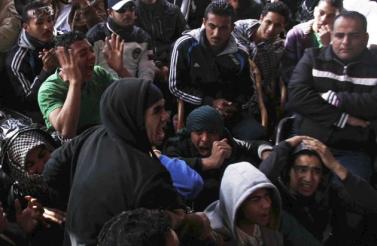
The most recent episode of wide scale violence occurred on Friday 22 March at the headquarters of the MB in Muqattam, Cairo, when secular-leaning demonstrators converged on the place to protest the increasing hegemony of the MB over the State in Egypt and to decry the curtailment of democracy. Clashes broke out between the demonstrators and MB supporters, resulting in some 210 injured and moved to Health Ministry hospitals, according to figures by the ministry. An official who asked to remain unnamed said the actual figure was closer to some 700, but most of these were moved privately to non-State hospitals and were not officially reported for fear of being caught by the police and charged with fomenting unrest.  
Many of the secular demonstrators were caught by MB supporters and moved to the nearby Bilal mosque where they were brutally tortured. The Coptic activist Amir Ayad was among them; he managed to escape and now lies in hospital under treatment from severe injuries all over his body, and a head cut which required 26 stitches to close.   
In the wake of the Muqattam incident, the Prosecutor-General Talaat Abdullah last Monday, ordered the arrest of five prominent political activists on charges of “inciting aggression against people, destruction of property and disturbing civil peace”. The arrest warrants followed a threat on Sunday by Mursi to take “necessary measures” against any politician involved in the unrest.
“We feel under threat. We feel this a total reversal for democracy,” said Khaled Daoud, a spokesman for the National Salvation Front, an alliance of non-Islamist parties. The 6 April pro-democracy activist movement wrote on its Facebook page:
“Why are arrest warrants only issued when there are clashes at the Brotherhood headquarters?”

Headed towards civil war?
Both seculars and Islamists exchange blame for the street battles and violence. Islamists allege that the seculars’ rejection of Mursi’s attempts at dialogue and their incessant street protest against him make it impossible for him to run the country.  
Seculars, for their part, insist Mursi’s alleged attempts at dialogue are mere cosmetic moves in which the seculars have never been taken seriously, and only serve to endow Mursi’s Islamist rule with legitimacy. They insist the street protests by the secular forces have always been largely peaceful.
“The Muqattam protest,” according to Shehab Waguih, spokesman for the secular Free Egyptians political party, “started peacefully but turned violent at the hands of the MB supporters who attacked the demonstrators. The protest was the outcome of the wrath of ordinary Egyptians at the MB hegemony over the State and its incompetence at running the country. This wrath has now by far exceeded any anger the Egyptians felt against police brutality or even against the Mubarak regime.”  
Another secular politician, the head of the Egyptian Social Democratic Party Ahmed Fawzy, fears that Egypt might be headed towards civil war. “The presidency is the real one to blame for the Muqattam violence,” Fawzy says, “since it has handed over the State to the MB and at the same time offered nothing to meet the demands of Egyptians. It is now obvious the MB has no vision whatsoever of how to pull Egypt out of the political, economic, and security quagmire it is now in because of their failure to run the country.”

No winners
Watani took the issue of the increasing violence on the Egyptian street to Mohamed Khalil, professor of social psychology at Ain Shams University. “The rampant violence reflects the absence of any serious dialogue between the different factions,” Dr Khalil says. “The responsibility lies with those in power, since they are the ones in charge of meeting the demands of the people. The violence is a normal reaction to a policy of ignoring these demands; the voice of the masses will always be heard, if not peacefully then violently. The violence and counter violence may potentially lead to civil war.”
Egyptians are collectively suffering frustration, Dr Khalil says. The demands of their revolution two years ago are yet unmet, which might very well lead to more violence unless the needs and demands of the people are answered.
“The MB, who are today in power,” he says, “should understand that they bear the responsibility of cooperating with the other forces in the community and at least meet the people midway. Otherwise, we all stand to lose. There are no winners in a civil war.”

WATANI International
31 March 2013

Comments

comments

Tags: Egyptianstakeviolence

Related Posts

China’s Long March launches USD190M tyre manufacturing project in Egypt
Economy

China’s Long March launches USD190M tyre manufacturing project in Egypt

June 17, 2026
Watani talks to Anba Bigol, Bishop and Abbot of al-Muharraq Monastery of the Holy Virgin Mary
Coptic Affairs

Watani talks to Anba Bigol, Bishop and Abbot of al-Muharraq Monastery of the Holy Virgin Mary

June 17, 2026
‘Train of Hope’ to carry home 1,200 Sudanese
E Choise

‘Train of Hope’ to carry home 1,200 Sudanese

June 16, 2026
Egypt launches ROX Motor partnership to manufacture new-energy vehicles
E Choise

Egypt launches ROX Motor partnership to manufacture new-energy vehicles

June 16, 2026
Developing skilled workforce for SCZone
Economy

Developing skilled workforce for SCZone

June 15, 2026
Jobs for persons with disabilities
NewsLine

Jobs for persons with disabilities

June 15, 2026

Editorial

China and Russia vis-à-vis Trump’s Iran War

More

MOST READ

Egypt attempts to contain Myna bird invasion
Environment

Egypt attempts to contain Myna bird invasion

June 15, 2026
0

The Nature Protection Sector of Egypt’s Ministry of Local Development and Environment has been monitoring and tracking the spread of...

Read more
Watani talks to Anba Bigol, Bishop and Abbot of al-Muharraq Monastery of the Holy Virgin Mary

Watani talks to Anba Bigol, Bishop and Abbot of al-Muharraq Monastery of the Holy Virgin Mary

June 17, 2026
Egypt’s Armenians

Egypt’s Armenians

April 22, 2015
‘Train of Hope’ to carry home 1,200 Sudanese

‘Train of Hope’ to carry home 1,200 Sudanese

June 16, 2026
Jobs for persons with disabilities

Jobs for persons with disabilities

June 15, 2026

Features

China’s Long March launches USD190M tyre manufacturing project in Egypt
Economy

China’s Long March launches USD190M tyre manufacturing project in Egypt

June 17, 2026
0

China’s Chaoyang Long March Tyre Co., Ltd. has launched a USD190 million tyre manufacturing project in Egypt’s Suez Canal Economic...

Read more
Watani started as an Egyptian weekly Sunday newspaper published in Cairo. The word Watani is Arabic for “My Homeland”. The paper was founded in 1958 by the prominent Copt Antoun Sidhom (1915 – 1995), who strove for the establishment of a civil, democratic society in Egypt, where all Egyptians would enjoy full citizenship rights regardless of their religious denomination. To this day when Watani is published as a weekly paper and an online news site, the objective remains the same. Those in charge of Watani view this role as a patriotic all-Egyptian vocation. Special attention is given to shedding light on Coptic culture and tradition as authentically Egyptian, this being a topic largely disregarded or little-understood by Egypt’s media. Watani is deeply dedicated to offer its readers high quality, extensive, objective, credible and well-researched media coverage, with special focus on Coptic issues, culture, heritage, and contribution to Egyptian society.
-----------------------------------------------------------

27 Abdel Khalek Tharwat st, Downtown, Abdeen,Cairo

00202-23927201

00202-23935946

 [email protected]


categories

  • News
  • Opinion
  • Politics
  • Culture
  • Egypt – Arab Spring
  • Coptic Affairs
  • Features
  • Watani Special Features

Recent Posts

  • China and Russia vis-à-vis Trump’s Iran War
  • China’s Long March launches USD190M tyre manufacturing project in Egypt
  • Watani talks to Anba Bigol, Bishop and Abbot of al-Muharraq Monastery of the Holy Virgin Mary
  • ‘Train of Hope’ to carry home 1,200 Sudanese
  • Egypt launches ROX Motor partnership to manufacture new-energy vehicles
  • News
  • Opinion
  • Politics
  • Culture
  • Egypt – Arab Spring
  • Coptic Affairs
  • Features
  • Watani Special Features

Powered BY 3A Digital.

No Result
View All Result
  • News
    • Accidents
    • Crime
    • Diplomatic briefcase
    • NewsLine
    • Outside Cairo
    • Special Occasions
  • Opinion
    • Editorial
    • International media
    • Reader`s Corner
    • Opinion
  • Politics
    • Elections
    • International Politics
    • Islamisation Politics
    • National Affairs
    • Parliament
    • Politics
    • Protests
    • Rights
    • Terrorism
  • Culture
    • Antiquity
    • Art
    • Books
    • Culture
    • Drama
    • Egyptology
    • Festivals
    • Films
    • Heritage
    • Islamisation Culture
    • Media
    • Museums
    • Music
    • TV
  • Coptic
    • Church Affairs
    • Coptic Affairs
    • Coptic Culture
    • Copts in the Media
    • Coptology
    • Copts Abroad
    • Religious
      • P. Shenouda: Bible Study
    • Sectarian
    • Inter-religious
    • Holy Family
  • Features
    • Counselling Corner
    • features
    • Economy
      • Business
    • Education
    • Social Issues
      • Behaviour
      • Mothers Day
    • Health
    • Environment
    • Humour
    • In memorial
    • Interviews
    • Nile
    • Profile
    • Special needs
    • Sports
    • Technology
    • Tourism
    • Wars
    • Women
    • Youth
  • Watani Special Features
    • Egypt – Arab Spring
      • 25 January Revolution
      • 25 Jan revolution, one year on
      • Egypt post-30 June
    • Watani Milestones
      • 20 years Watani International
      • 10 years Watani International
      • Watani Jubilee
    • Pope Shenouda
    • Pope Tawadros
    • Watani Forum

Powered BY 3A Digital.

Login to your account below

Forgotten Password?

Fill the forms bellow to register

All fields are required. Log In

Retrieve your password

Please enter your username or email address to reset your password.

Log In