
Editor in Chief
Youssef Sidhom
Watani
عربى English French
  • News
    • Accidents
    • Crime
    • Diplomatic briefcase
    • NewsLine
    • Outside Cairo
    • Special Occasions
  • Opinion
    • Editorial
    • International media
    • Reader`s Corner
    • Opinion
  • Politics
    • Elections
    • International Politics
    • Islamisation Politics
    • National Affairs
    • Parliament
    • Politics
    • Protests
    • Rights
    • Terrorism
  • Culture
    • Antiquity
    • Art
    • Books
    • Culture
    • Drama
    • Egyptology
    • Festivals
    • Films
    • Heritage
    • Islamisation Culture
    • Media
    • Museums
    • Music
    • TV
  • Coptic
    • Church Affairs
    • Coptic Affairs
    • Coptic Culture
    • Copts in the Media
    • Coptology
    • Copts Abroad
    • Religious
      • P. Shenouda: Bible Study
    • Sectarian
    • Inter-religious
    • Holy Family
  • Features
    • Counselling Corner
    • features
    • Economy
      • Business
    • Education
    • Social Issues
      • Behaviour
      • Mothers Day
    • Health
    • Environment
    • Humour
    • In memorial
    • Interviews
    • Nile
    • Profile
    • Special needs
    • Sports
    • Technology
    • Tourism
    • Wars
    • Women
    • Youth
  • Watani Special Features
    • Egypt – Arab Spring
      • 25 January Revolution
      • 25 Jan revolution, one year on
      • Egypt post-30 June
    • Watani Milestones
      • 20 years Watani International
      • 10 years Watani International
      • Watani Jubilee
    • Pope Shenouda
    • Pope Tawadros
    • Watani Forum
No Result
View All Result
  • News
    • Accidents
    • Crime
    • Diplomatic briefcase
    • NewsLine
    • Outside Cairo
    • Special Occasions
  • Opinion
    • Editorial
    • International media
    • Reader`s Corner
    • Opinion
  • Politics
    • Elections
    • International Politics
    • Islamisation Politics
    • National Affairs
    • Parliament
    • Politics
    • Protests
    • Rights
    • Terrorism
  • Culture
    • Antiquity
    • Art
    • Books
    • Culture
    • Drama
    • Egyptology
    • Festivals
    • Films
    • Heritage
    • Islamisation Culture
    • Media
    • Museums
    • Music
    • TV
  • Coptic
    • Church Affairs
    • Coptic Affairs
    • Coptic Culture
    • Copts in the Media
    • Coptology
    • Copts Abroad
    • Religious
      • P. Shenouda: Bible Study
    • Sectarian
    • Inter-religious
    • Holy Family
  • Features
    • Counselling Corner
    • features
    • Economy
      • Business
    • Education
    • Social Issues
      • Behaviour
      • Mothers Day
    • Health
    • Environment
    • Humour
    • In memorial
    • Interviews
    • Nile
    • Profile
    • Special needs
    • Sports
    • Technology
    • Tourism
    • Wars
    • Women
    • Youth
  • Watani Special Features
    • Egypt – Arab Spring
      • 25 January Revolution
      • 25 Jan revolution, one year on
      • Egypt post-30 June
    • Watani Milestones
      • 20 years Watani International
      • 10 years Watani International
      • Watani Jubilee
    • Pope Shenouda
    • Pope Tawadros
    • Watani Forum
No Result
View All Result
No Result
View All Result
Watani
ع Fr
ADVERTISEMENT

Getting back on track

15 December, 2011 - (9:06 AM)
0 0

Salwa Stephen

Getting back on track
39
VIEWS
Share on FacebookShare on Twitter

WATANI International
5 December 2010


The street children question needs to be handled with great caution—on every level. For good or ill, the issue is hemmed in by security planning and legal procedures. Social experts tend to approach both the children and the problem indirectly via short accidental encounters which, they hope, might result in attracting the children to a rehabilitation centre. Once there, the children interact with specialists and social workers through various activities aimed at reforming their behaviour in order to reunite them with their families or to induce them to adequately re-mingle with the community.  
A workshop on interactive and rehabilitating activities which can be adopted with street children was held recently under the auspices of Plan International (PI) and was attended by social activists working in the field.


Ending child poverty
Working under the motto “Promoting child rights to end child poverty”, PI is one of the oldest and largest children’s development organisations in the world. It works in 48 developing countries across Africa, Asia and the Americas to promote child rights and lift millions of children out of poverty. PI works through the donations of more than one million people in more than 18 donor countries. An average 80 per cent of donations go directly to support programmes benefiting children and families.
PI has been working in Egypt since 1981, and its team here is led by Edward Mac Abbey. It works towards helping poor children to access their rights to health, education and protection. Mac Abbey makes a point of having regular meetings with the street children.
The workshop was organised by Ashraf Ashraf, head of PI’s unit south of Cairo, and Amira Gebali, the street children’s programme coordinator of the same unit. It was directed by Mohamed Tageddin, a training consultant with the Hope Village Society (HVS) in Cairo.


Identifying stereotypes
Tageddin relayed examples of the stereotypes that he meets as a social expert, such as the talkative personality, the over-confident, the aggressive or the authoritarian person. He explained that there were factors shaping the personality of every type, and a specific approach to deal with each in order to tame it. He added that communicating with a street child primarily depended on how the child responded to the social specialist, and to what extent he trusted him and was at ease with him. In order to secure the street child’s confidence, the social specialist should respect a number of procedures, such as careful listening, open discussion and proper dialogue, in order to understand exactly what the child means. In addition, the social worker should be gentle and sensitive at all times, no matter what pressure he may be under in his work or how ill-behaved the child is. The social worker must always express his concern for the child and be familiar with the particular slang employed by the street children, especially the codes that they sometimes use in their speech among each other.
According to Tageddin, the social specialists’ role does not stop at discussions; it extends to performing activities that reveal some hidden aspects of the children’s personalities, whether positive or negative, and discover their talents and IQ levels. The social worker should strive to mingle with the children in order to attract them to the centre and to help them personally rather than deal with them in an arrogant manner.
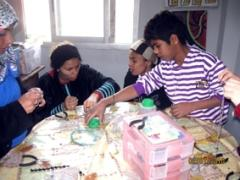
“Drawing; playing with dough; making paper masks; organising trips to the zoo, museums or beaches; biking; watching puppet shows, these are all activities in which the social experts involve the street children who go the rehabilitation centres,” Tageddin said. During playtime, he added, attractive educational programmes have been implemented to combat illiteracy, and have led to children entering regular schools according to their age and academic level.


Multi-discipline
‘How to design a rehabilitation programme’ was the topic of several workshops. To begin with, homogeneous groups of street children are formed, respecting age groups and tendencies. All the needs of the group are then identified. The programme includes varied activities, such as artistic, sportive, social, leisurely, cultural and scientific pursuits. The work team comprises a doctor, a sociologist, a psychologist, a teacher and a professional rehabilitation specialist.
A child’s ‘group’ can assist in reforming behaviour and benefiting from others’ experiences. Tageddin told the audience of a previous experience which he called ‘the court’, and which he had applied with one of the groups. “At the end of each day the group used to gather around the child who had made more mistakes than most. The child would confess his mistakes, and then the group would sentence him to a certain appropriate punishment, such as washing the dishes or doing some cleaning. “This experience had a very positive impact on the children”, he concluded.


Positive activities
The workshop organisers divided the attendants into work groups. Each group was asked to suggest certain activities that would be useful for street children if they were assumed by the rehabilitation centres. Later a delegate from each group explained the importance of the activities selected by his or her group, as well as the activities’ prospective positive impact on the children. Among the activities suggested were drawing; playing with beads and dough; playing games; acting; singing; visiting museums and entertaining the children’s parents and some of their relatives at the centres.
The work groups also worked on setting up comprehensive rehabilitation programmes for the street children residing in temporary residence centres. Each group began by determining the age group it was handling, and then designed a detailed schedule from wake-up call to bedtime. The suggested programmes concentrated on cleanliness and hygiene routines, sports, and education through games. Activities that could develop into handicrafts and which would yield income for the children and help them make a living, were supported by most of the groups.
One of the NGOs working in the field recommended, within its tentative schedule, a weekly meeting with public figures. Every week the centre would entertain a film or football star, or a State representative, who would meet the children and help inspire them towards a better future. This easy-going encounter with a famous personality, as suggested by the NGO, would offer a flicker of hope for the children and might make them respond to the advice given.


Job hazards
Amal al-Sayed, a social specialist with the Fustat Society told Watani about the hazards that the social worker faces, among which the lack of authority. “If the police decide to arrest or pick up a street child with whom I am in contact, I immediately have to step back and try not to intervene, otherwise I can face trouble,” said Sayed. She added that social workers were sometimes harassed by teenage-street children, which was why social workers had to be very cautious and alert to any alarming sign while working with a street child.
Marwa al-Hariry from Banati (literally ‘my daughters’) Association says that very simple gestures can endear the social worker to the street children and make them respond quickly. “When we go to meet them in their street assembly points, they welcome us and offer us soft drinks and snacks”, she told Watani.
Tageddin told Watani that he cherished all the street children with whom he dealt. “They are all victims”, he said. He told us about a very special case in which one teenager decided to leave home out of her own free will, even though she had never been subjected to any kind of harassment or aggression from her parents or anyone else. “She headed for the street because she could not live under the ‘constraints’ of home life,” he said. Fortunately the girl, who was both beautiful and strong, was able to defend herself against sexual harassment during her street days. “Dealing with her was no easy task; it took years to rehabilitate her and to convince her to go back home, especially when living on the street had been her own choice,” Tageddin said She later married and had children, and finally she appreciated home life. Tageddin said that even though this case was unusual it was a tremendous challenge. Most children living on the streets are forced into a way of life they would not have chosen.
Hope Village does indeed live up to its name. “Many of our children have gone on to university. HVS supports them after graduation to buy flats, and sometimes we help them start small projects,” Tageddin said.


Comments

comments

Tags: back?Gettingtrack

Related Posts

Jobs for persons with disabilities
NewsLine

Jobs for persons with disabilities

June 15, 2026
Again: NCCM rescues girls from underage child marriage
E Choise

Again: NCCM rescues girls from underage child marriage

June 2, 2026
Child helpline to the rescue
features

Child helpline to the rescue

April 28, 2026
Child marriage tackled through religious address and social media
Features

Child marriage tackled through religious address and social media

March 9, 2026
Egypt launches waie.net for child online protection
Culture

Egypt launches waie.net for child online protection

February 25, 2026
Monasteries donate food boxes Ramadan
Coptic Affairs

Monasteries donate food boxes Ramadan

February 23, 2026

Editorial

China and Russia vis-à-vis Trump’s Iran War

More

MOST READ

Egypt attempts to contain Myna bird invasion
Environment

Egypt attempts to contain Myna bird invasion

June 15, 2026
0

The Nature Protection Sector of Egypt’s Ministry of Local Development and Environment has been monitoring and tracking the spread of...

Read more
Watani talks to Anba Bigol, Bishop and Abbot of al-Muharraq Monastery of the Holy Virgin Mary

Watani talks to Anba Bigol, Bishop and Abbot of al-Muharraq Monastery of the Holy Virgin Mary

June 17, 2026
Egypt’s Armenians

Egypt’s Armenians

April 22, 2015
‘Train of Hope’ to carry home 1,200 Sudanese

‘Train of Hope’ to carry home 1,200 Sudanese

June 16, 2026
Jobs for persons with disabilities

Jobs for persons with disabilities

June 15, 2026

Features

China’s Long March launches USD190M tyre manufacturing project in Egypt
Economy

China’s Long March launches USD190M tyre manufacturing project in Egypt

June 17, 2026
0

China’s Chaoyang Long March Tyre Co., Ltd. has launched a USD190 million tyre manufacturing project in Egypt’s Suez Canal Economic...

Read more
Watani started as an Egyptian weekly Sunday newspaper published in Cairo. The word Watani is Arabic for “My Homeland”. The paper was founded in 1958 by the prominent Copt Antoun Sidhom (1915 – 1995), who strove for the establishment of a civil, democratic society in Egypt, where all Egyptians would enjoy full citizenship rights regardless of their religious denomination. To this day when Watani is published as a weekly paper and an online news site, the objective remains the same. Those in charge of Watani view this role as a patriotic all-Egyptian vocation. Special attention is given to shedding light on Coptic culture and tradition as authentically Egyptian, this being a topic largely disregarded or little-understood by Egypt’s media. Watani is deeply dedicated to offer its readers high quality, extensive, objective, credible and well-researched media coverage, with special focus on Coptic issues, culture, heritage, and contribution to Egyptian society.
-----------------------------------------------------------

27 Abdel Khalek Tharwat st, Downtown, Abdeen,Cairo

00202-23927201

00202-23935946

 [email protected]


categories

  • News
  • Opinion
  • Politics
  • Culture
  • Egypt – Arab Spring
  • Coptic Affairs
  • Features
  • Watani Special Features

Recent Posts

  • China and Russia vis-à-vis Trump’s Iran War
  • China’s Long March launches USD190M tyre manufacturing project in Egypt
  • Watani talks to Anba Bigol, Bishop and Abbot of al-Muharraq Monastery of the Holy Virgin Mary
  • ‘Train of Hope’ to carry home 1,200 Sudanese
  • Egypt launches ROX Motor partnership to manufacture new-energy vehicles
  • News
  • Opinion
  • Politics
  • Culture
  • Egypt – Arab Spring
  • Coptic Affairs
  • Features
  • Watani Special Features

Powered BY 3A Digital.

No Result
View All Result
  • News
    • Accidents
    • Crime
    • Diplomatic briefcase
    • NewsLine
    • Outside Cairo
    • Special Occasions
  • Opinion
    • Editorial
    • International media
    • Reader`s Corner
    • Opinion
  • Politics
    • Elections
    • International Politics
    • Islamisation Politics
    • National Affairs
    • Parliament
    • Politics
    • Protests
    • Rights
    • Terrorism
  • Culture
    • Antiquity
    • Art
    • Books
    • Culture
    • Drama
    • Egyptology
    • Festivals
    • Films
    • Heritage
    • Islamisation Culture
    • Media
    • Museums
    • Music
    • TV
  • Coptic
    • Church Affairs
    • Coptic Affairs
    • Coptic Culture
    • Copts in the Media
    • Coptology
    • Copts Abroad
    • Religious
      • P. Shenouda: Bible Study
    • Sectarian
    • Inter-religious
    • Holy Family
  • Features
    • Counselling Corner
    • features
    • Economy
      • Business
    • Education
    • Social Issues
      • Behaviour
      • Mothers Day
    • Health
    • Environment
    • Humour
    • In memorial
    • Interviews
    • Nile
    • Profile
    • Special needs
    • Sports
    • Technology
    • Tourism
    • Wars
    • Women
    • Youth
  • Watani Special Features
    • Egypt – Arab Spring
      • 25 January Revolution
      • 25 Jan revolution, one year on
      • Egypt post-30 June
    • Watani Milestones
      • 20 years Watani International
      • 10 years Watani International
      • Watani Jubilee
    • Pope Shenouda
    • Pope Tawadros
    • Watani Forum

Powered BY 3A Digital.

Login to your account below

Forgotten Password?

Fill the forms bellow to register

All fields are required. Log In

Retrieve your password

Please enter your username or email address to reset your password.

Log In