
WATANI International
30 May 2010
Carmen
For the second time this year, within the space of two months, and owing to the wonderful reception given to the first performance, the Cairo Opera House (COH) has presented Bizet’s Carmen. The four performances presented earlier this month on the stage of the Main Hall won standing ovation from an enraptured audience. Abdel-Moniem Kamel directed the show, combining stage scenery and lighting to produce a magnificent effect.
Collaborating to make the show a success were the Cairo Opera Orchestra conducted by the American Peter Tiboris, the Cairo Opera Ballet Group, as well as the Cairo Opera Choir and the Acapella Choir. The Cairo Opera’s top singers, among whom were Julie Faizi, Mustafa Mohamed, Iman Mustafa, and Mona Rafla took part, as well as the Serbian mezzosoprano Dragana del Monaco, the French tenor Jean Noel Briend, and the Italian tenor Franscesco Anile.
Carmen, written by the French writer Prosper Merimee, in 1875, is one of the best loved ballets. It tells the story of the sensual, almost savage gypsy girl, Carmen, whose love of freedom above all else brings her, and the men who love her, to tragic ends.
Tribute to Petipa
To mark a century since the death of the French ballet dancer and choreographer Marius Petipa, the COH hosted six dancers from Cuba and Russia: Gulsina Maviliukasova, Ildar Maniapov, Guzel Suleymanova, Dimitri Marasanov, Anastacia Isupova, and Evgen Svietlitsa, who presented three performances of “Gala of Dance to pay tribute to Petipa” in Cairo and Alexandria.
The performances included duets from classical ballets such as the Sleeping Beauty, the Nutcracker, La Bayadere, Don Quichote, Giselle, and Swan Lake, which Petipa re-choreographed in the 19th century with his exceptional vision and sense of the dance.
Marius Petipa was born in 1819 in Marseilles and died in 1910. Marius Petipa is considered one of the greatest choreographers of all time. He researched the subject matter of the ballets he staged, making careful and detailed preparations for each production, and then worked closely with the designer and composer. Petipa elevated the Russian ballet to international fame and laid the cornerstone for 20th century ballet. His classicism integrated the purity of the French school with Italian virtuosity.
The Moon over Helan Mountain
At the foot of the Helan Mountain and just on the west bank
of the Yellow River in northern China, there lies the Ningxia
Plain, a beautiful place with plentiful water and lush grass. Several hundred years ago, a group of Arab merchants reach this idyllic spot in a state of extreme fatigue, having overcome immeasurable risks on the way as they crossed the famous Silk Route. A young shepherdess, Hai Zhen, tending her flock in the plain, is terrified at the sight of the strangers, but her father talks to them, understands their plight, and persuades the local villagers to offer them food, drink, and shelter. The handsome young Arab, Nasru, who is the son of the leader of the merchants, falls in love with the pretty Chinese girl, but both their parents resist the young couple who wish to marry, on the pretext of the widely different cultures they belong to.
The group of Arab merchants depart and the lovers are forced to part. But again, as they cross the desert home, the merchants are attacked by bandits. Nasru’s father is fatally wounded and, while on his deathbed, Hai Zhen comes to visit him. He is so moved by the trouble she took to show an act of kindness to him, that he agrees to his son marrying her. They settle, with many of their merchant friends, at the foothill of the mountain, becoming the ancestors of the Hui Muslim Chinese.
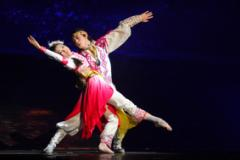
The romance is the topic of the first Chinese full-length dance drama, four performances of which were presented at the COH earlier this month. The performances were presented by the Yinchuan Art Troupe, and were the culmination of the joint efforts of the Egyptian Foreign Ministry, the Chinese embassy, and the COH.
The show brims with Muslim Chinese traditions and dance, such as the knife dance and the western region dance. The audience, captivated by the grace and expression of the dancers, was introduced to a culture entirely new to Cairenes. For this reason especially, the COH and the Chinese embassy had decided that attendance of the show would be free of charge, through invitations obtained from the Chinese embassy. The four performances were sold out.